I really enjoyed writing this piece. How often does one get to quote Lewis Carroll in the title? Plus Boojum is a really cool name to say.

This article was originally published in Airspace vol. 2 no. 11, September 2011. It is posted here with permission and has approved for public release case number 12-1433.
“For the Snark was a Boojum, you see.”*
By Tony Chong
Perhaps no two companion aerospace projects have had a more
whimsical set of names given to them than the heritage Northrop Snark and
Boojum. Yet, like the fantastical
creatures featured Lewis Carroll’s nonsensical poem, the Snark and Boojum were
meant to be deadly as well.
In 1945 the U.S. Army Air Force’s Air Material Command
issued a block of ten MX-designated research and study contracts to several
companies for various advanced missile designs. Half of them were allotted for subsonic and
supersonic Surface-to-Surface Missiles, of which three were to be ultimately
built as air-breathing cruise missiles.
Northrop was awarded one of these contracts, MX-775, in
March of 1946. MX-775A was for a subsonic
intercontinental cruise missile, which eventually became the Snark. The MX-775B was for a supersonic
intercontinental cruise missile. It was
christened by the company as Boojum.
In December of 1946, the funding for Snark was deleted from
the budget, but the more technically difficult Boojum survived. After lobbying by Jack Northrop himself,
Snark was reinstated in 1947 with the promise that it would only take two and
one-half years to develop. Boojum was
retained as well, but now as the follow-on system to Snark.
1947 saw the formation of the U.S. Air Force as its own
branch and the Snark was designated SSM-A-3 and the Boojum SSM-A-5. “X” was added as a prefix to indicate the
experimental nature of the programs at this stage.
The early version of the Boojum bears a distinct similarity
to the early Snark. Both had in-house
N-25 designations, with N-25A for Snark and N-25B for Boojum (each would
acquire new N-numbers later on, the Boojum in particular being noted as N-217
in some internal documents). Both also
carried thin, highly swept-wings on a long, semi-tailless fuselage. A small vertical fin adorned each vehicle’s
aft end. However, Snark had a high-mounted
wing with a flush belly inlet, while Boojum sported a mid-fuselage wing and an
annular inlet.
The final Boojum version would show a radical departure from
the early configuration. Ultimately the
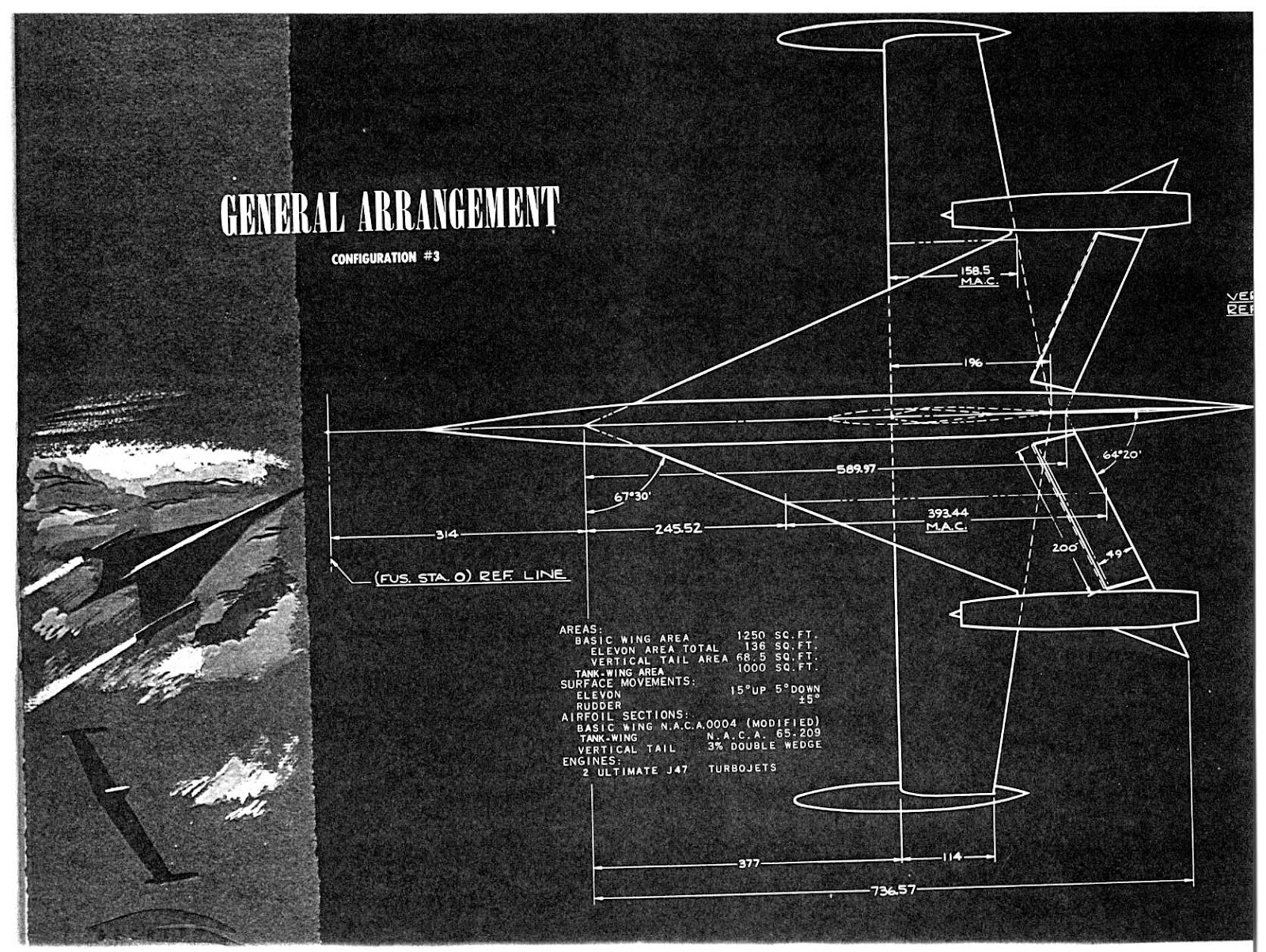
missile was to be a semi-tailless, delta-winged vehicle that would reach 85.33
feet in length and have a span of 50.85 feet.
Missile construction was to feature a conventional
semi-monocoque fuselage with aluminum alloy-faced, honeycomb core
bulkheads. The skin of the Boojum was to
be made from a non-strategic magnesium alloy.
An “ultimate short-life” afterburning General Electric J47
turbojet was to be mounted near the tips of the wings, each providing 13,620
pounds of static thrust. Engine life was
estimated to be 25 hours, but the life of the continuous-use afterburners was only
required to be 4.5 hours – the duration of a typical mission at Mach 1.8 with
expendable drop tank.
Estimated top speed was Mach 2.0 at 66,600 feet, with a
range of nearly 3,400 miles clean and 4,980 miles with drop tank. Maximum ceiling and range were 70,000 feet
and 3,510 miles clean or 5,080 miles with tank at Mach 1.8. All figures factored in the 3,000 lb.
“special” (nuclear) warhead as the payload.
Alternate engines were available for use, with the primary
one being the proposed General Electric XJ53.
Other types, including the General Electric/Allison J35 and Westinghouse
J40 were considered as well, but more as a stop-gap measure if the J47 or XJ53
were unavailable for the test phase.
Like the Snark, the Boojum was to be guided to its target by
the Northrop-designed Automated Celestial Navigation (ACN) system. This system, which marked the start of
Northrop’s Electronics “Nortronics” Division, utilized an automatic day/night
star-tracking sextant and associated avionics that weighed nearly one ton.
Boojum could be rail-launched in either a single or
two-stage configuration. The first stage
component was a large 80.5 foot span straight-wing attachment with
wingtip-mounted fuel tanks. The wing
mounted to the belly of Boojum via a massive pylon that remained with the first
stage when it detached.
Boojum was also designed to be air launched from a large
carrier aircraft. Mounted on the top of
the mothership because of its size, it resembled the recently retired 747/Space
Shuttle combo.
Wind tunnel and rocket-boosted atmospheric models tests of
the Boojum proceeded through the late 1940s, but by the start of the new decade
customer confidence in the viability, accuracy and performance of the
supersonic cruise missile waned. The
program was cancelled in 1951.
Snark would continue, but its path was long, difficult and
marginally successful. While the system
did eventually attain operational status with the 702nd Strategic
Missile Wing in February, 1961, its life was short. The first U.S. intercontinental ballistic
missile went operational months earlier in September 1959, rendering the in-coming
Northrop vehicle obsolete. The 702nd
SMW was deactivated four months later. Like the Baker in Carroll’s poem, Northrop’s
aptly named cruise missiles softly and suddenly vanished away, never to be met
with again.
*The Hunting of the Snark by Lewis Carroll. http://books.google.com/books?id=TLoNAAAAYAAJ&printsec=frontcover&dq=The+Hunting+of+the+Snark#v=onepage&q&f=false
Additional information about the Boojum can be found at the
following links:
An interesting book called The Evolution of the Cruise Missile, by Kenneth P. Werrell, Air
University Press, Maxwell AFB, 1985, can be found in pdf. format here:
Photo Captions
 img779 – This scan
of the N-25 3-view drawing comes from the in-house publication Northrop:
An Aeronautical History, by Fred Anderson, Northrop Corp., 1976, (the
“Brown Book”) and shows the early Snark configuration. Note the flush inlet and high-mounted
wings. Tony Chong collection.
img779 – This scan
of the N-25 3-view drawing comes from the in-house publication Northrop:
An Aeronautical History, by Fred Anderson, Northrop Corp., 1976, (the
“Brown Book”) and shows the early Snark configuration. Note the flush inlet and high-mounted
wings. Tony Chong collection. xssm-a-5
– A drawing of the early Boojum configuration shows the similarities
with the early Snark. The main
external differences are with the mid-mounted wings and annular inlet. Image
credit USAF
xssm-a-5
– A drawing of the early Boojum configuration shows the similarities
with the early Snark. The main
external differences are with the mid-mounted wings and annular inlet. Image
credit USAF 100_0007_3 – Northrop issued a
brochure in 1950 in an attempt to highlight the advantages of the Boojum
to the customer. This is a photo of
the very dynamic cover art. The
artist is unknown, but it is very reminiscent of Jack Leynnwood, who
occasionally worked for Northrop, but who also worked for the Revell and
Aurora model kit companies, where he did a lot of their boxtop artwork. Photo
credit: Tony Chong
100_0007_3 – Northrop issued a
brochure in 1950 in an attempt to highlight the advantages of the Boojum
to the customer. This is a photo of
the very dynamic cover art. The
artist is unknown, but it is very reminiscent of Jack Leynnwood, who
occasionally worked for Northrop, but who also worked for the Revell and
Aurora model kit companies, where he did a lot of their boxtop artwork. Photo
credit: Tony Chong img736 – The brochure contained
this baseline 3-view drawing of the Boojum. As noted in the text, the vehicle was
over 85 feet long; a very impressive size even today. While the engines are far apart,
Northrop projected minimal control disruption with asymmetric thrust and
was supposed to retain enough engine-out performance on take-off to direct
the vehicle to a safe ditching point away from the base or populated
areas. Tony Chong collection.
img736 – The brochure contained
this baseline 3-view drawing of the Boojum. As noted in the text, the vehicle was
over 85 feet long; a very impressive size even today. While the engines are far apart,
Northrop projected minimal control disruption with asymmetric thrust and
was supposed to retain enough engine-out performance on take-off to direct
the vehicle to a safe ditching point away from the base or populated
areas. Tony Chong collection. img735 – This scan from the brochure shows the 3-view drawing
of the Boojum and its large expendable fuel tank. The tank slips over the bottom fuselage
of the missile and extends beyond the nose and tail, increasing the length
nearly 20 feet. The sidebar art
shows the tank being dropped in flight.
Tony Chong collection.
img735 – This scan from the brochure shows the 3-view drawing
of the Boojum and its large expendable fuel tank. The tank slips over the bottom fuselage
of the missile and extends beyond the nose and tail, increasing the length
nearly 20 feet. The sidebar art
shows the tank being dropped in flight.
Tony Chong collection. img734
– Another artist’s concept shows a larger image of the Boojum, two
with tanks and one in the midst of dropping a tank. In real life separation would have been
an interesting issue at Mach 2 for an unmanned vehicle carrying a
conformal tank longer than itself. Tony Chong collection.
img734
– Another artist’s concept shows a larger image of the Boojum, two
with tanks and one in the midst of dropping a tank. In real life separation would have been
an interesting issue at Mach 2 for an unmanned vehicle carrying a
conformal tank longer than itself. Tony Chong collection. img771 – This plan-view drawing shows the Boojum with it
straight-wing first stage. Like the
basic missile, the two-stage configuration was rail-launched. Note the size of the wing and the tip
tanks. The sidebar shows the first
stage dropping away from the missile.
Tony Chong collection.
img771 – This plan-view drawing shows the Boojum with it
straight-wing first stage. Like the
basic missile, the two-stage configuration was rail-launched. Note the size of the wing and the tip
tanks. The sidebar shows the first
stage dropping away from the missile.
Tony Chong collection. img772 – The profile and front view of the two-stage
configuration shows the massive size of the pylon attaching the vehicles
together. The acceleration stresses
during rail launch are interesting to consider. All of the thrust appears to come from
the Boojum’s two J47 engines. No
mention is made anywhere in the brochure of expendable rocket or jet
assisted devices. Tony Chong collection.
img772 – The profile and front view of the two-stage
configuration shows the massive size of the pylon attaching the vehicles
together. The acceleration stresses
during rail launch are interesting to consider. All of the thrust appears to come from
the Boojum’s two J47 engines. No
mention is made anywhere in the brochure of expendable rocket or jet
assisted devices. Tony Chong collection. img773 – Another, larger artist’s concept showing a couple of Boojums
in operation, one with its first stage attached and the other dropping its
stage. The art shows the drop
taking place over land, which seems rather unlikely in real life. In all probability Boojum basing would
be near coastal areas and the drop points would be over water. Tony
Chong collection.
img773 – Another, larger artist’s concept showing a couple of Boojums
in operation, one with its first stage attached and the other dropping its
stage. The art shows the drop
taking place over land, which seems rather unlikely in real life. In all probability Boojum basing would
be near coastal areas and the drop points would be over water. Tony
Chong collection. img777 – This
image shows some of the interior structure of the first stage. The inset art appears to highlight one
of the pylon attach points. What
looks like wiring could be part of an explosive bolt triggering mechanism
for first stage separation. Unfortunately the various launch configuration
drawings appear to be from a second brochure, not all of which was copied,
so details are elusive. Tony Chong collection.
img777 – This
image shows some of the interior structure of the first stage. The inset art appears to highlight one
of the pylon attach points. What
looks like wiring could be part of an explosive bolt triggering mechanism
for first stage separation. Unfortunately the various launch configuration
drawings appear to be from a second brochure, not all of which was copied,
so details are elusive. Tony Chong collection. img778
– Ironically, one of the launch aircraft considered for the Boojum was
the Convair B-36 Peacemaker. This
is a later version of the B-36 as it has the twin-engine jet pods outboard
of the buried main piston engines.
The jets are non-afterburning General Electric J47-GE-19s, from the
same family as the Boojum’s engines.
Tony Chong collection.
img778
– Ironically, one of the launch aircraft considered for the Boojum was
the Convair B-36 Peacemaker. This
is a later version of the B-36 as it has the twin-engine jet pods outboard
of the buried main piston engines.
The jets are non-afterburning General Electric J47-GE-19s, from the
same family as the Boojum’s engines.
Tony Chong collection. img776 – The final image is
intriguing not just for the Boojum on the back of the mothership, but for
the mothership itself. It is a
swept-wing, swept-tail, four engine turboprop version of the B-36 with
counter-rotating blades. This is
likely an early concept for what eventually became the jet-powered,
eight-engine YB-60. Note the
mushroom cloud in the background.
Since the aircraft are over land, and the two are still together,
one can assume a strike has been made against the American homeland and a
retaliatory launch is moments away. Tony Chong collection
img776 – The final image is
intriguing not just for the Boojum on the back of the mothership, but for
the mothership itself. It is a
swept-wing, swept-tail, four engine turboprop version of the B-36 with
counter-rotating blades. This is
likely an early concept for what eventually became the jet-powered,
eight-engine YB-60. Note the
mushroom cloud in the background.
Since the aircraft are over land, and the two are still together,
one can assume a strike has been made against the American homeland and a
retaliatory launch is moments away. Tony Chong collection